
Garage floor epoxy in Kansas City
Epoxy and polyaspartic garage floors, specified after we test your slab rather than before. Licensed and insured, family-owned, free proposals within one business day.
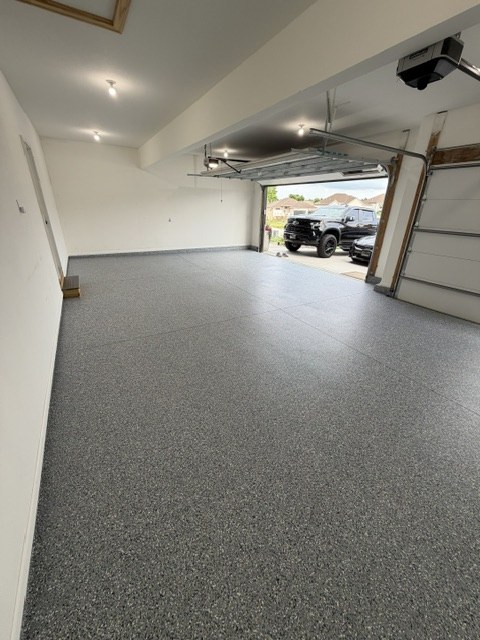
What a garage floor coating actually is
The garage takes more abuse than any floor in the house: hot tires, road salt, dropped tools, and oil drips. Our garage epoxy is a chemically bonded surface harder than the concrete under it, finished in a decorative flake that hides wear and still looks like the day it was poured. Available in a range of flake blends and solid colors.
What it is not is paint rolled over concrete. Bare concrete is porous. It drinks in oil, brake fluid, and the salt brine that drips off a car all winter, and it dusts up onto everything stored in the garage. Once the surface starts pitting, the freeze-thaw swings we get every Kansas City winter work into those pits and widen them. A bonded coating closes the surface so nothing gets in, and leaves you a floor you mop instead of one you sweep and re-sweep.
- Hot-tire and chemical proof. Tires, salt, oil, and solvents wipe up instead of staining.
- Harder than the slab. Engineered for vehicles, jacks, and heavy foot traffic.
- Seals the concrete completely. No more dusting, pitting, or moisture stains.
- Decorative flake finish. A showroom look that hides dirt between cleanings.
Used in attached and detached garages, workshops, and shop bays.
Epoxy or polyaspartic? How we decide
We install both as standalone systems, so we have no reason to talk you into either one. They are genuinely different materials with genuinely different strengths, and the right answer depends on your slab rather than on what we would rather sell.
Where epoxy wins
Epoxy builds thickness. On a slab that has been ground open properly it keys deep into the concrete and fills the small imperfections a thinner coating would telegraph straight through. That build is why it takes jack stands, dropped tools, and stored weight so well, and why it stays the practical choice across large floor areas.
Where polyaspartic wins
Polyaspartic is UV stable, so it does not amber the way a standard epoxy will under sustained direct sun. It stays more flexible, which matters on a slab that moves with the freeze-thaw swings we get here, and it returns a floor to service sooner. That combination makes it the stronger answer on sun-exposed bays and on slabs with a history of movement.
How we choose
We moisture-test the slab, then look at how much direct sun the floor actually gets, whether the concrete is cracking or moving, what gets spilled on it, and how long you can keep the cars out. Those five answers decide the system. If both would serve you equally well we will say so, and let cost break the tie.
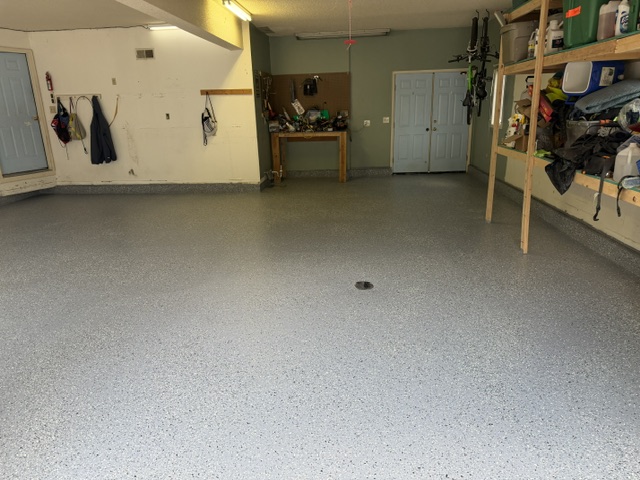
We test the slab before we quote it
Most residential shops price a garage off a square-foot number and a photo. We come out, we moisture-test the concrete, and what the reading says changes what we specify.
Prep is what decides whether the floor lasts
Almost every failed garage floor you have seen failed for one of three reasons, and all three are prep problems rather than product problems.
Moisture coming up through the slab
Concrete poured on grade pulls moisture from the ground beneath it. If that vapour has nowhere to go once the floor is sealed, it collects under the coating and pushes it off in sheets. This is the most common reason a garage floor peels, and it is invisible until it happens. It is also why we test first: the reading tells us whether the slab needs a moisture-tolerant specification before anything else goes down.
A slab that was never opened up
A troweled concrete floor is sealed tight at the surface. Coating straight over it leaves the resin sitting on top with nothing to grip. We mechanically grind the slab to open the pores so the coating keys into the concrete instead of resting on it. This is the step that separates a floor that lasts from a floor that lifts at the first hot tire.
Cracks and pitting left buried
A coating follows the shape of whatever is under it. Spalled edges, pop-outs, control joints, and old patch work all have to be cut out and rebuilt before the finish goes on, or they read straight through the new floor and keep moving underneath it. We repair the concrete as part of the job rather than as a change order after we arrive.
What the job looks like
No demolition and no tear-out, so the house stays livable the whole time.
-
On-site assessment and moisture test
An owner comes out, measures, tests the slab, and looks at how the space is actually used. Free, and no obligation either way.
-
Written proposal
The system we recommend, why that one, the schedule, the cure window, the warranty, and itemized pricing. In writing, before anything is committed.
-
Grind, repair, and prep
We mechanically profile the slab, cut out and rebuild cracks and spalls, and handle control joints deliberately. This is the longest part of the job and the part that decides the outcome.
-
Base coat and flake
The bonding coat goes down, and the flake blend is broadcast into it if you have chosen a flake finish. The excess is then scraped back flat.
-
Topcoat, cure, and walkthrough
The clear topcoat seals the finish. We walk the floor with you, confirm the cure window before you park on it, and leave the site clean.
Recent garage floors
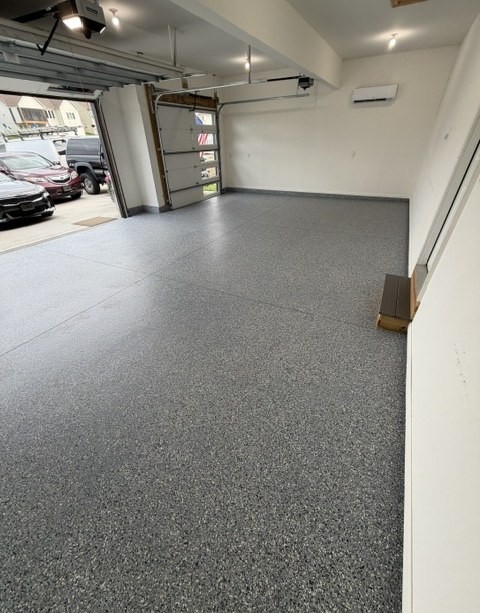
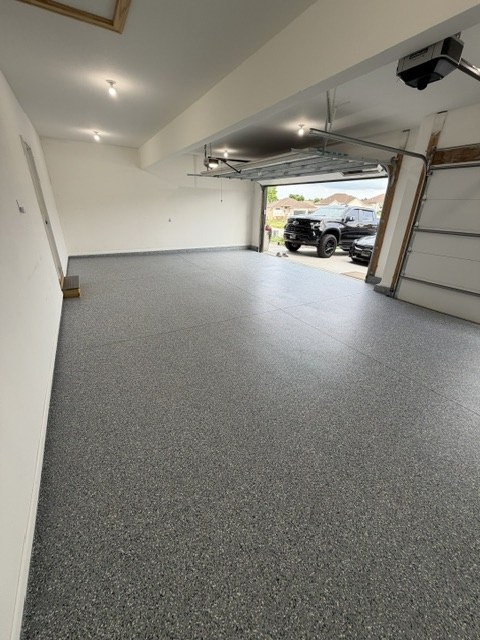
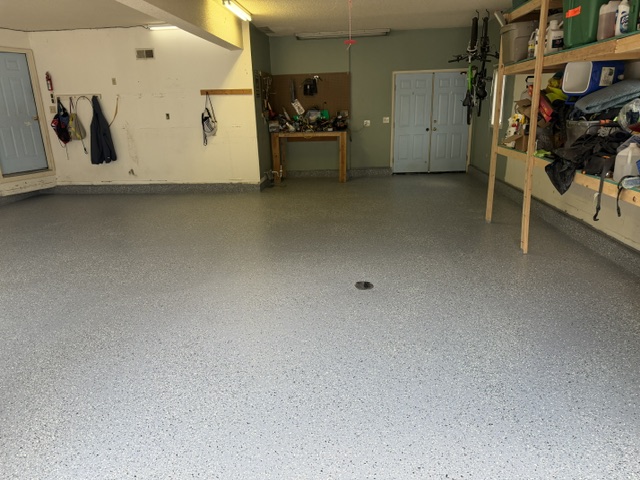
More finished work in the project gallery.
What is warrantied, and what it costs
Every surface we coat carries a workmanship warranty, from 1 to 15 years depending on the surface and the system specified. The exact term for your garage is written into your proposal before you commit to anything, not quoted verbally on the driveway. If our workmanship fails, we make it right.
Coating a surface typically saves 50 to 70% against a full tear-out and replacement, and coating projects generally start around $1,500 and up. Exact pricing is itemized in your written proposal. Payment plans are available as well, if the timing on cost is the obstacle — see payment options.
We are a licensed and insured, family-owned LLC based in the Kansas City metro. The owners are the people who come out, write the proposal, and answer the phone.
Garage floor epoxy FAQ
Have a question we haven't covered? Call or text us and ask.
Request a ProposalWill an epoxy floor peel off my slab?
Not if the slab is prepped for what it actually is. Peeling almost always traces back to moisture pushing up through the concrete, or to a floor that was coated without being mechanically ground open first. We moisture-test before we quote and we grind rather than acid-etch, so the specification you get is written for your slab rather than copied off the last one.
Doesn't epoxy turn yellow in the sun?
A standard epoxy will amber under sustained direct sunlight. Most garage floors sit in shade and never see enough UV for it to matter, but the strip inside a south-facing door can. That is exactly what the on-site assessment is for: where sun exposure is a real factor we specify a UV-stable polyaspartic instead, because we install both systems and have no stake in which one you end up with.
Will it survive hot tires and road salt?
Yes, when it is bonded into the concrete rather than sitting on top of it. Hot-tire pickup is a symptom of a weak bond, not of the resin itself. Salt brine, oil, and solvents sit on the surface of a finished floor and mop off, instead of soaking into the slab the way they do on bare concrete.
How long before I can park on it again?
Garage floors are measured in days, not weeks, and because there is no demolition the rest of the house stays completely livable. Every coating needs a cure window before vehicles go back on it, and foot traffic comes back sooner than vehicles do. The exact dates for your floor are confirmed in your written proposal and again at the walkthrough.
My garage floor is cracked and pitted. Is it too far gone?
Usually not. Cracks, spalled edges, pop-outs, and old patches get cut out and rebuilt during prep, and control joints are handled deliberately rather than coated over and left to reopen. If a slab genuinely is past coating, we will tell you so instead of taking the job. That is a much smaller conversation than a floor that fails in a year.
Do you offer payment plans?
Yes. Payment plans are available, checking your options takes about two minutes, and it does not affect your credit score. See payment options, or request a proposal first if you would rather have a real figure to work from.
Other floors we coat
Traditional Epoxy Flooring
The same family of systems, built for basements, shops, warehouses, and commercial floors.
Concrete & Driveway Sealing
The driveway, apron, and walkways outside the garage door, sealed against salt and freeze-thaw.
All services
Every coating and flooring system we install, in one place.
Get your garage floor priced properly
Free, no-obligation proposals from a licensed and insured local company. We respond within one business day.